THE REMOTE CONSULTING BLUEPRINT
The problem with remote isn’t the camera.
For dog trainers and behavior consultants: 6 skills for working with the human, not just the dog. These are what make online sessions work, and make you a better consultant everywhere else.
Get the course - $277
In person, your hands can fill in the gaps.
You take the leash. You show the client how to do the thing. You fix it in the moment.
Remote takes all of that away. It’s just you, a laptop, and a stressed-out human trying to describe their stressed-out dog. Your hands sit helplessly in your lap while the client mis-marks again.
In remote sessions, your human skills carry the whole case: a history that actually tells you something, clients who can see what you need them to see, instructions they can follow, questions that don’t sound like accusations, and feedback that sticks after you log off.
Those skills were always the job. Remote just makes them non-negotiable.
As Pet Harmony co-owner Ellen Yoakum puts it, working in person made her a better trainer. Working remotely made her a better consultant.
Everything you'll learn in this course works in person too. Practice on Tuesday’s in-home, use it on Thursday’s Zoom.

The 6 skills that carry a remote case:
1. Walk into session one already knowing what's going on
The intake form comes back, and you still have no idea what's going on. You'll learn what every question on our history worksheet is for, which answers are red flags, and how to adapt it to your niche. That way session one starts with a hypothesis, not a fishing trip.
2. Get the video on the first try (OK, maybe the second)
No more saying "Can you film it again?" for the third time. You'll get the video you need on the first or second try, and you'll fix a bad camera angle with words alone. Watch Emily do it live with her own dog.
3. Finally trust what clients tell you
"He was fine!" He was not fine. Teach clients where their dog is on the ladder of escalation, and their reports become something you can trust. Most clients pick it up between session one and session two. Bonus: management stops quietly falling apart once clients understand what it's for.
4. Teach any skill with your hands in your lap
You watch the client fumble the leash, and you can't reach through the screen. You'll learn to break any skill into short, clear instructions clients can follow and even repeat to themselves. In one case, two words fixed a client's leash pops.
5. Ask questions that don't sound like accusations
"Would you be open to trying something else?" lands like an accusation, and the client digs in. You'll get 10 question types, each with an "instead of this, try this" swap. They cover prong collars, "he's just dominant," and the client who won't stop talking.
6. Send feedback that actually gets results
You send detailed feedback, and next week nothing has changed. The missing piece is almost never the video. It's the written instructions that go with it. You'll get a lean workflow for both.
Plus the business side:
Getting clients on board with virtual, starting before you feel ready, and why remote should cost the same as in-person.
What's Inside:

Intro:
Remote consulting, not remote training
Why the difference matters, and what a course can and can't do for you.
Module 1
Environmental Arrangements
Setting your client up to succeed, so you get accurate information without being physically in the room.
Skills 1–3: history taking, seeing remotely, and creating reliable observers.

Module 2
Human Instruction
Teaching the person, not just the pet.
Skills 4–6: teaching without touching, asking better questions, and video feedback.
Includes a full mock session with Squish Face McGee, mistakes and all.

Module 3
FAQs
Short, opinionated answers to what everyone asks:
How do I get good enough?
How do I convince clients to go virtual?
How do I market it, price it, and handle tech support? (Spoiler: you don't do tech support.)

Bonus Resources
- Our current history worksheet that we use with every client
- The full list of questions from Skill 5
- A flowchart for helping clients move off aversive tools on their own terms
"Yeah, but..."
You've probably already thought of these. Good! So did we.
"I can't see the dog."
"My clients can't set up a camera."
"I can't trust what clients report."
"I can't teach a skill without my hands on the dog."
"Video feedback isn't as good as being there."
"My clients won't want virtual."
"I'm not good enough to do this yet."
"I don't have time for another course."
"I've wasted money on courses before."

Who it's for (and who it isn't)
This is for you if...
- You're a trainer or behavior consultant who wants to add remote sessions or get better at it.
(Not doing remote yet? Practice every skill on your in-person clients first.) - You've noticed most cases go sideways with the human, not the dog.
- You believe how you treat people is part of the work.
This probably isn't for you if...
- You want a one-size-fits-all script so you don't have to think about the individual animal.
- You think a plan fails because the client didn't comply or the dog is "too difficult."
- You think any tool is fine as long as it "works."
Meet Your Instructor: Emily Strong
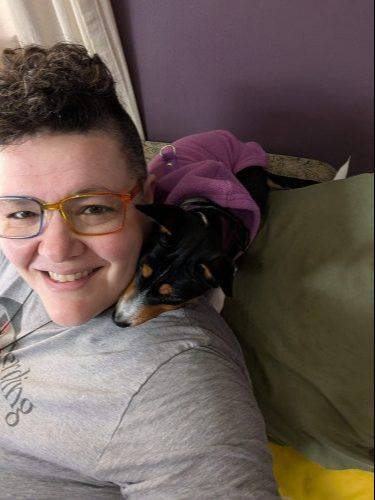
Emily is co-owner of Pet Harmony and has been consulting remotely since 2014, back when it was weird and before the pandemic made it normal.
She co-authored Canine Enrichment for the Real World and is a co-host of the Enrichment for the Real World podcast.
Along the way, you'll hear about:
- A dog barking at night who didn't need counter-conditioning. He needed a new protein.
- A dog who wasn't "barking for no reason."
He was guarding his person from someone in the house. - How two words fixed a client's leash pops.
- Squish Face McGee, demo dog since 2017 and the most patient learner you'll ever meet.
Yes, there are mistakes in the videos. She kept them in so you can watch her fix them.
"I have taken other professional courses, and not one of them addresses the interpersonal and self-reflective skills needed for long-term sustainability and thriving in this profession. This [course] has given me a blueprint to develop those skills."
-Abbie Duchon, PETPro member

The Remote Consulting Blueprint - $277
- All 6 skills, plus the business side: 11 on-demand lessons
- 1 year of access
- 4.5 CEUs (CCPDT, PPG, and IAABC)
- The course workbook
- Our current history worksheet
- The full question list from Skill 5
- The aversive-tools flowchart
FAQ's
How long do I have access?
Do I need to be doing remote sessions already?
Is it just for dogs?
Is there live support?
Will this teach me to market remote services?
You don't need to get good before you start. You get good by starting.
You already know how to change a dog's behavior. Come learn the other half.
NICE TO MEET YOU!
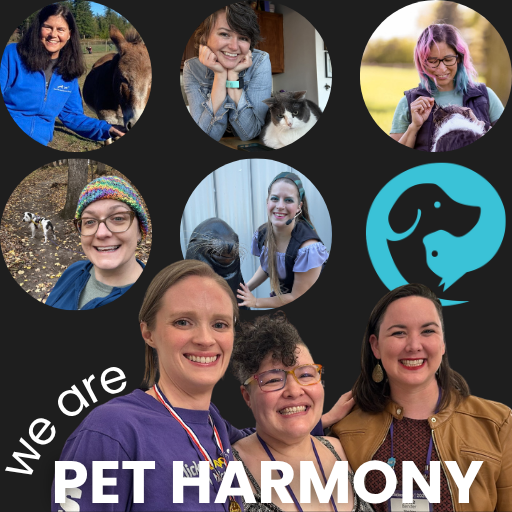
We Are Pet Harmony
We're a behavior consulting team, and we teach other pet professionals the same systems our consultants use with every client. We're the people behind PETPro, the Enrichment for the Real World podcast, and Canine Enrichment for the Real World.